
A sculptural perfume bottle presents an unusual design challenge: its shape must communicate the concept, but those same contours also influence how the bottle, closure and packaging are developed. The more a design depends on a particular silhouette, the more important it becomes to preserve that silhouette through physical development.
This HIVEDA concept explores that relationship through a fully custom glass bottle, a faceted resin cap design and a coordinated presentation box. A physical prototype or sample already exists, while the supplied concept renders show additional visual directions. The development question is how to retain the intended sculptural character while resolving the practical relationships between the components.
A Silhouette Built Around Light and Proportion
The bottle’s most important feature is the relationship between its broad shoulders and recessed waist. The upper body expands outward from a relatively narrow neck, while the sides curve inward before widening again toward the base. Angular transitions interrupt these curves, creating a silhouette that changes noticeably from the shoulder to the lower body.
This geometry gives the bottle an identity that does not depend on a large printed label. The broad shoulder line, narrowing middle and substantial-looking base establish the overall form. The raised edges and recessed central areas then introduce a second layer of visual interest through reflections and apparent glass depth.
In the amber render, light passing through the bottle creates bright highlights around its outer contours, while the central area appears darker. This contrast emphasizes the changes in surface direction and draws attention to the bottle’s sculpted profile. The design uses transparency and geometry together rather than treating the glass body as a neutral container.
Because this is a fully custom glass bottle, those proportions are central to the development brief. The challenge is not simply to reproduce a decorative outline. The shoulder transitions, recessed sides and lower contours must be translated into a physical structure while preserving the visual relationship established by the concept.
The Cap as the Second Half of the Sculpture
The bottle’s flowing contours are contrasted by a sharply geometric cap that rises to a pointed crown-like top. Its faceted surfaces create a different rhythm of highlights from those on the glass body, giving the upper component an independent sculptural character.
That contrast is deliberate in the visual composition. The cap extends the bottle’s vertical profile, while its angular construction echoes the more restrained edges running through the glass. Together, the two components form a continuous silhouette without repeating exactly the same geometry.
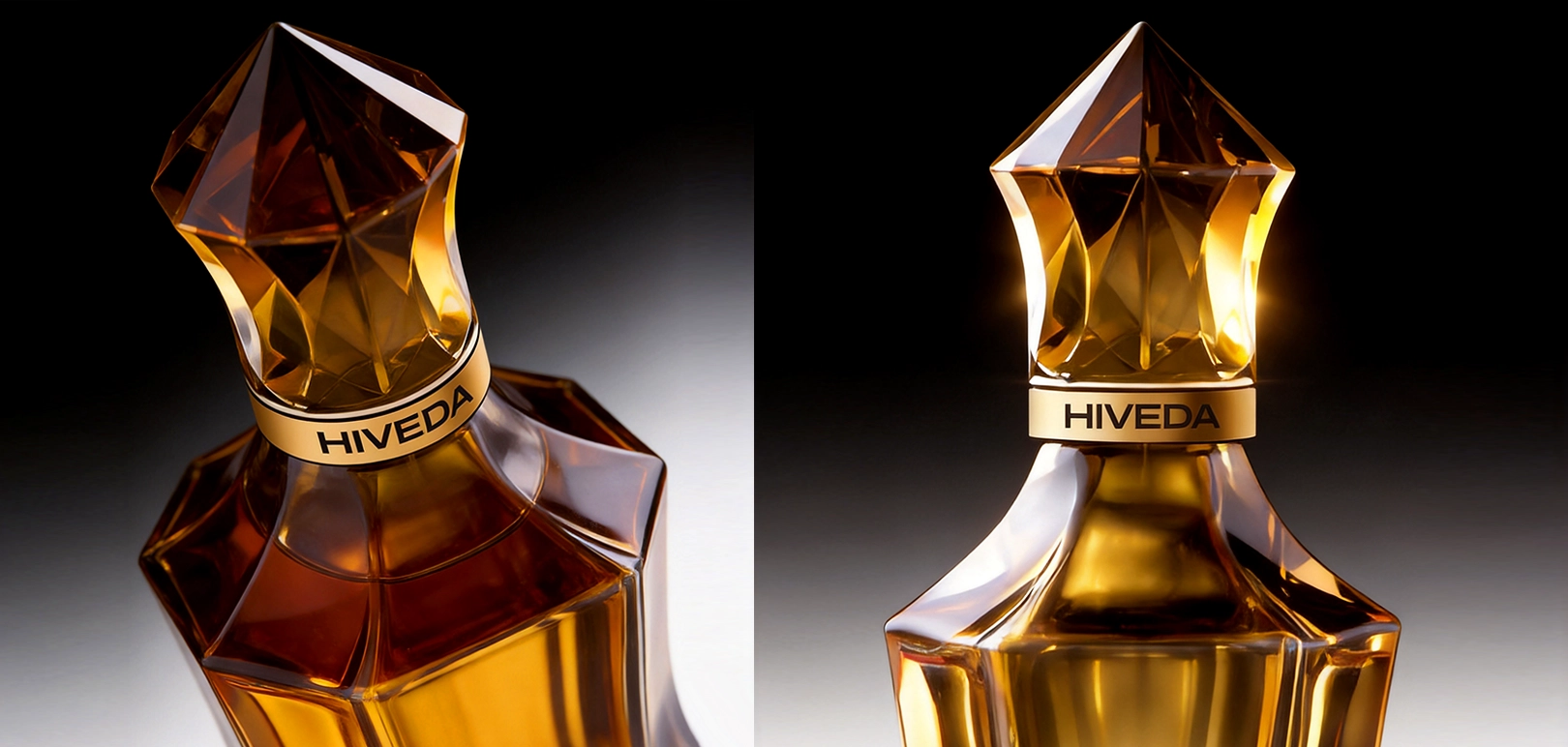
The gold-tone neck band plays an important part in this transition. It creates a clear boundary between the cap and bottle, provides a defined position for HIVEDA branding and introduces a horizontal element between two strongly vertical forms. Without that intermediate detail, the visual transition between the pointed cap and widening shoulders would be considerably more abrupt.
The intended resin cap also introduces its own development considerations. The selected resin specification, construction, internal fitting and final weight would need to support the desired external form. The cap’s alignment with the bottle is especially important because its pointed top and angular facets make any departure from the intended orientation visually apparent. These details require physical evaluation rather than being settled by the render.
Color Studies and the Presentation Relationship
The concept is shown in three rendered color directions: amber, deep blue and burgundy. Each retains the same overall bottle and cap geometry, allowing the color studies to demonstrate how differently the sculpted surfaces respond to changes in transparency, darkness and reflected light.

The amber direction makes the relationship between the outer contours and the recessed center particularly visible. The darker blue and burgundy studies place greater emphasis on surface highlights and the outer silhouette. These are visual explorations of the design rather than confirmed commercial variants or separate fragrance products.
The presentation box extends the design beyond the bottle itself. The supplied render shows a tall rectangular structure with dark exterior panels, a contrasting warm brown central area, visible stitch-like detailing and a narrow vertical accent. The central panel widens toward its upper and lower ends, creating a visual relationship with the bottle’s changing proportions.

The presentation box is part of the intended development scope, although its exact construction and materials remain to be established. Its design must therefore address two related needs: maintaining the visual connection with the bottle and providing suitable protection for the complete assembled product. The appearance of stitching or leather-like surfaces in the render does not, by itself, establish the materials or processes that will be used.
Translating Sculptural Geometry into a Development Brief
A physical prototype or sample already exists for this concept, providing a basis for further development. That progress is distinct from confirming the final production route or validating every component. The next technical decisions should concentrate on the features that contribute most directly to the intended design.
The first priority is the fully custom glass body. Its recessed sides, broad shoulders and shaped base create transitions that would require careful review during glass development. Mold construction, glass distribution, achievable surface definition and the relationship between the external shape and internal capacity would need to be evaluated against the intended dimensions and production requirements. The existing sample provides a reference, but the evidence supplied does not establish that these characteristics have been validated for production.
The second priority is the resin cap and its connection to the bottle. The external faceted shape needs to be reconciled with the internal fitting, closure interface and expected handling characteristics. In particular, cap weight, retention and alignment should be assessed using the selected pump and neck configuration. A visually accurate cap is only one part of a complete closure system.
The third priority is the presentation box. Its internal structure and protective insert should be developed around the actual bottle and cap dimensions rather than solely around the rendered silhouette. Particular attention should be given to the upper cap and the projecting glass contours, as these determine where the assembled product may require clearance and support during handling and transport.
These interdependent decisions illustrate the purpose of bespoke perfume development . For a fully custom bottle, the glass body, closure and packaging cannot be treated as unrelated design tasks. Changes to the proportions of one component may affect the fit, appearance or construction of the others.
Which Design Features Must Survive Development?
The central development decision is to establish which features define the concept and which details can be adjusted as technical requirements become clearer. The broad shoulders, recessed waist and transition into the pointed cap establish the main sculptural relationship. These elements should form the basis of the design brief before secondary construction details are finalized.
Other decisions can be evaluated against that relationship. A revised cap fitting, an adjustment to an internal glass contour or a different box construction may be considered if it addresses a practical requirement without undermining the intended external composition. The aim is to distinguish between changes that alter the design’s character and those that allow its character to be preserved in a physical product.
HIVEDA’s role in this process is to connect design development with the relevant production partners and coordinate the bottle, cap and packaging requirements. Its product development and supply-chain coordination services can support the technical reviews, sampling, quality control and subsequent execution required by the agreed project scope.
The value of the concept lies in the relationship between its parts. Its custom glass geometry establishes the silhouette, the resin cap completes the sculptural profile, and the box extends that design language into the product’s presentation. Developing those elements as a connected system provides a clearer basis for deciding which features to preserve, refine and validate before committing to production.