
A Gemstone-Inspired Bottle Built on Faceted Glass
BD-PF-10 is a bespoke perfume bottle concept built around faceted tinted glass, vertical reflection, and rose-gold metal contrast. The bottle body has a polygonal profile, with flat panels that catch light differently from each angle. This gives the concept a gemstone-like presence without relying on heavy surface decoration.
The strength of this direction is the relationship between geometry and color. The purple, green, and smoky blue versions share the same faceted structure, but each color changes the mood of the bottle. Purple feels more evening-led, green feels deeper and botanical, while smoky blue gives the structure a cooler, more restrained direction.
This concept could work for a boutique fragrance line, a gift-focused private label perfume, a jewel-tone collection, or a modern feminine fragrance range. A brand using this design language would need to treat the bottle as a small display object, not only as a fragrance container.
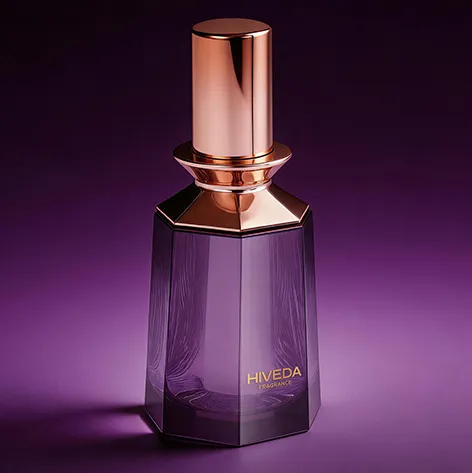
For brands exploring bespoke perfume bottle design, BD-PF-10 shows how a recognizable silhouette can be created through glass geometry, cap proportion, and controlled color variation.
How Rose-Gold Details Shape the Silhouette
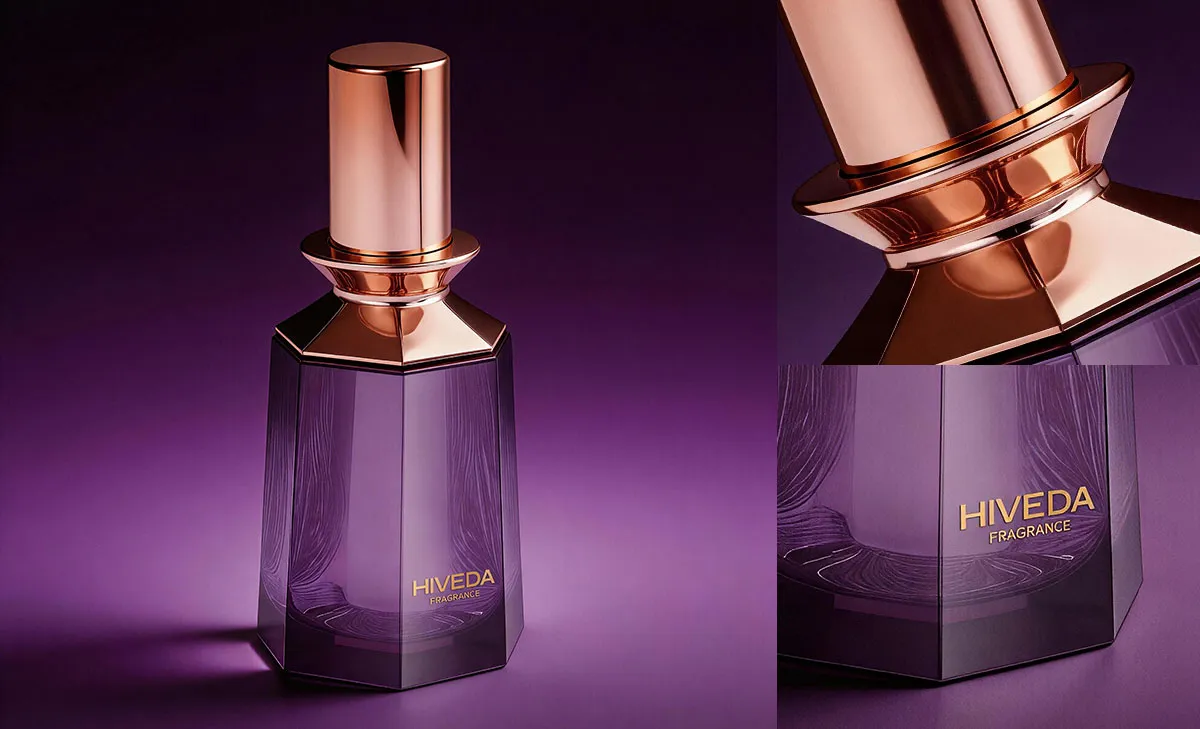
The rose-gold cap does more than close the bottle. It changes the vertical balance of the whole design. The tall cylindrical form adds height, while the flared collar below it creates a jewelry-like transition between the metal top and the faceted glass body.
This transition is important because the bottle body narrows toward the shoulder. Without the rose-gold collar, the cap could feel visually separated from the glass. The collar acts like a setting around a stone, giving the bottle a more intentional top structure.
The cap is smooth and reflective, while the bottle is angular and transparent. This contrast helps each material direction read clearly. The metal top gives the concept polish, while the faceted glass gives it depth and movement.
If developed physically, the cap height, cap diameter, collar thickness, and pump clearance would need to be reviewed together. A tall cap can make the silhouette stronger, but it can also create a top-heavy impression if the lower body is not wide or heavy enough.
Packaging That Matches the Metal and Color System
The outer box supports the bottle through a dark purple or burgundy base with rose-gold borders and a central rose-gold logo panel. This packaging direction works because it does not try to copy every facet of the bottle. Instead, it translates the bottle’s metal detail into a clean graphic structure.
The box should feel controlled because the bottle already has strong geometry. A dark background allows the rose-gold lines and central label panel to stand out, while also connecting with the purple bottle variant. The result is a more complete bottle-and-box system.
For this concept, color matching would be important. The cap finish, collar finish, box border, and central box label should sit within the same rose-gold family. If the cap looks copper while the box foil looks yellow-gold, the product set may feel disconnected.
The packaging should also be developed around the bottle’s shape. A faceted bottle needs a fitted insert that protects the edges and keeps the tall cap from rubbing against the box during transport. For a gift-focused launch, the opening experience should reveal the bottle upright and centered.
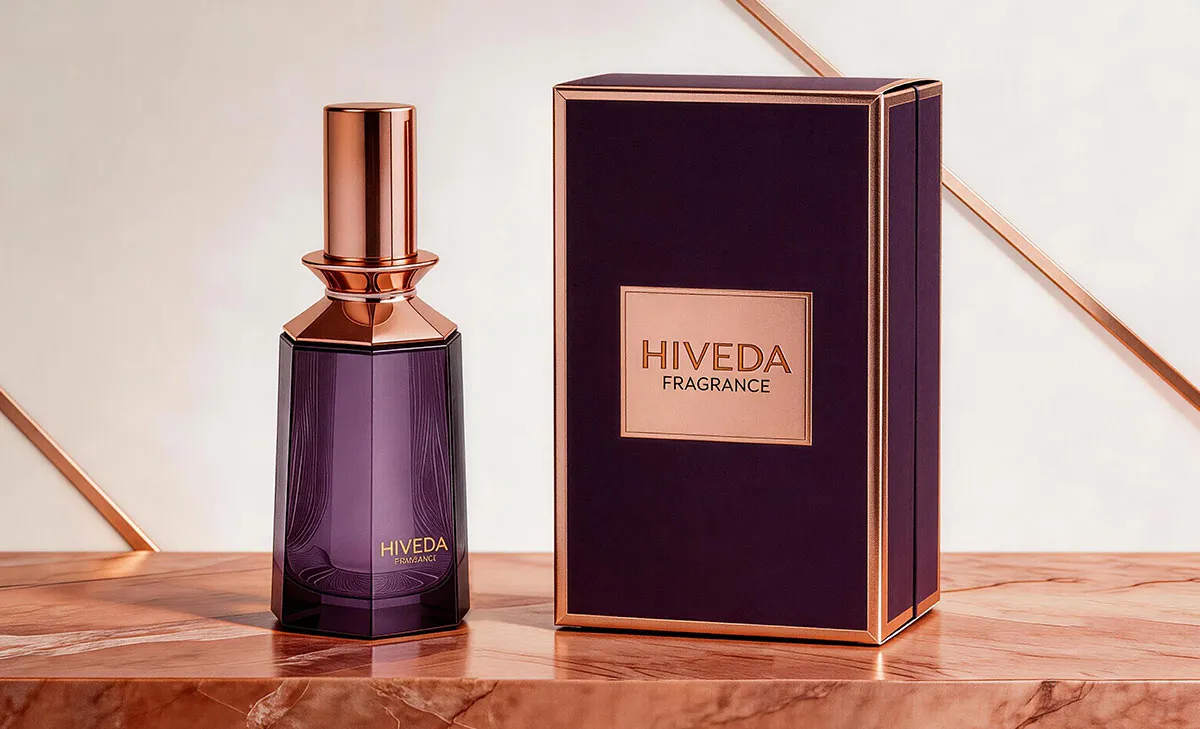
For fragrance brands planning a complete product set, HIVEDA’s perfume development support can help align bottle structure, cap finish, packaging material, and decoration testing before production decisions are made.
What Needs to Be Tested Before Sampling
If BD-PF-10 moves into physical development, the first checks should focus on the faceted glass body. The panel angles, edge definition, shoulder transition, base thickness, and internal volume all need to be reviewed in 3D before sampling.
Faceted bottles can look precise in concept images, but production requires controlled geometry. The edges must be sharp enough to create reflection, but not so sharp that they create weak points or difficult mold release. The base also needs enough weight to balance the tall cap.
The fine flowing linework visible on the glass would need a separate decoration decision. It could be explored through printing, decal, engraving, laser marking, or a molded surface detail. Each route would give a different result on tinted glass, so sample testing should check visibility, alignment, and repeatability.
The rose-gold finish also needs proofing. Cap plating, metallization, coating durability, scratch resistance, and color match with the box foil should be tested under real lighting. A highly reflective cap can show small defects more easily than a matte component.
Before confirming packaging, the box structure, inner tray, border alignment, foil sharpness, and cap clearance should be checked together. The bottle and box should not be approved as separate objects because the concept depends on their shared color and material language.
How HIVEDA Can Support BD-PF-10 Development
For a concept like BD-PF-10, HIVEDA can help move the design from visual direction into 3D modeling, proportion review, prototype discussion, and mold development evaluation. The faceted body, narrow shoulder, and tall cap should be studied together before any tooling decision is made.
HIVEDA can also support decoration and component testing, including tinted glass color proofing, rose-gold cap finishing, collar development, logo placement, and linework decoration tests. These steps are important because the concept relies on reflection, color depth, and metal consistency.
The packaging can be developed in parallel with the bottle. HIVEDA can support box structure, paper or coating selection, rose-gold foil proofing, insert design, and export-ready protection. This helps the bottle and box work as one product set instead of two separate components.
Once the direction is confirmed, HIVEDA can support the wider route through fragrance product development services, including sampling, filling, assembly, quality control, and export coordination. Brands interested in a similar faceted glass bottle direction can contact HIVEDA to discuss bottle geometry, cap finish, packaging format, and development feasibility.
FAQ
Frequently Asked Questions
Have questions about fragrance product development, customization, production, or export? Here are some common answers.
Q1: What is the main development challenge for BD-PF-10?
The main challenge is the faceted glass body. The panel angles, edge definition, shoulder transition, base thickness, and internal capacity need to be reviewed carefully. The bottle should create clear reflections without making the glass too fragile or difficult to mold.
Q2: Why is the rose-gold collar important in this concept?
The collar connects the tall cylindrical cap to the faceted bottle body. Without it, the cap could feel visually separate from the glass. The flared collar works like a jewelry setting, making the top structure feel intentional rather than simply attached.
Q3: What should be checked for the tall cylindrical cap?
The cap height, diameter, internal tolerance, pump clearance, weight, and rose-gold finish should all be checked. Because the cap is tall and reflective, small proportion issues or surface defects will be more visible than on a shorter matte cap.
Q4: How can the fine flowing linework on the bottle be produced?
Possible routes include screen printing, decal, engraving, laser marking, or molded surface detail. The best method depends on the desired depth, cost, visibility on tinted glass, and batch consistency. Sample testing should confirm that the linework stays visible without making the faceted body look too busy.