Most new perfume brands begin with a scent idea. Caeleste Parfums began with a cosmology.
Launched in Romania in 2024 under the creative direction of Ștefan Răduț, Caeleste builds its world around Christian angelology, sacred ritual and what the brand calls “An Architecture of the Invisible.” Guardian angels, archangels and principalities are not simply names applied to finished formulas. They shape the collection structure, perfumer briefs, imagery and physical design.
That is what makes Caeleste worth studying. The useful lesson is not that religious concepts sell perfume. It is that an unusually abstract idea becomes more convincing when scent, naming, packaging and visual identity all appear to belong to the same world.
A Spiritual Concept Needs a Product Logic
Spiritual language can become vague very quickly. Caeleste avoids part of that problem by giving its idea a hierarchy.
The debut collection follows three celestial roles: Guardian Angel, Archangels and Principalities. Instead of releasing an unrelated group of perfumes and explaining the connection afterward, the collection begins with a framework capable of generating products.
Guardian Angel leans toward comfort and protection, combining floral, musky, creamy and resinous elements. Archangels introduces a more dramatic contrast between luminosity and force. Principalities moves further into mineral, metallic and cosmic territory.
For a fragrance brand, this suggests a stronger starting question than “What three fragrances should we launch?” Ask instead: What rule makes these products belong together?
Once that rule exists, decisions around bottle decoration, cartons, naming, samples and future collection extensions become easier to edit.

Three Perfumers, One Celestial Ladder
Caeleste also made an unusually confident launch decision: three fragrances, three perfumers.
Chris Maurice created Guardian Angel. Cristiano Canali interpreted Archangels. David-Lev Jipa-Slivinschi created Principalities. The risk is obvious. Give three strong authors too much independence and you can end up with three impressive perfumes that feel as if they came from three different brands.
Caeleste uses the celestial hierarchy as the editorial control.
The briefs do not need identical olfactory signatures because each fragrance occupies a different role inside the same narrative. That creates room for contrasting interpretations without forcing every perfume to repeat the same incense, resin or religious reference.
That is useful for creative directors working with outside perfumers. Coherence does not require every formula to smell related. It requires a clear reason for their differences.
A tightly edited three-product launch can therefore feel larger than three SKUs. Each fragrance reveals another part of the world while leaving room for future expansion.

Make the Invisible Physical
A concept called “Architecture of the Invisible” creates a difficult packaging brief: how do you make something deliberately immaterial feel physical?
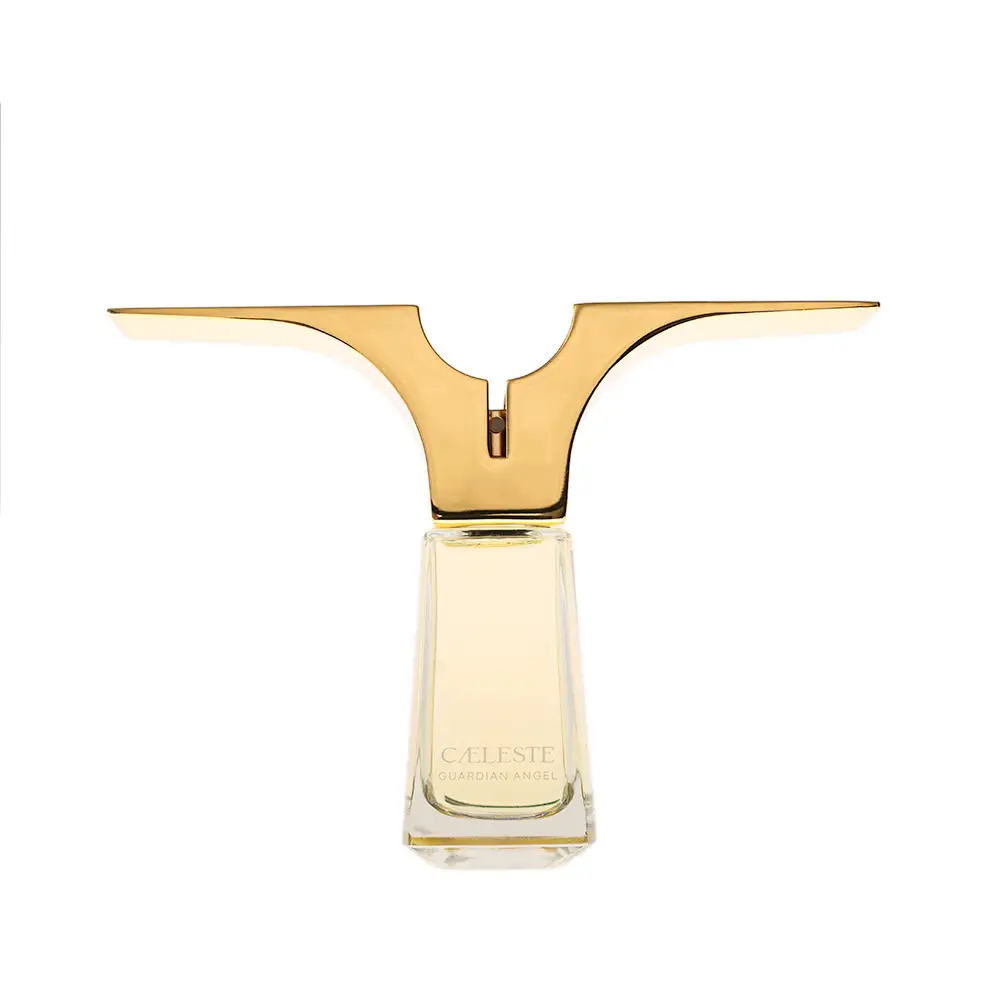
Caeleste answers through geometry. Its object design draws on sacred geometric forms, while the broader visual language translates ideas of light, ritual and spirituality into a contemporary physical object.
This is where many concept-led fragrance projects become weaker. The founder has a rich story, the perfumer understands it, but the bottle eventually becomes a standard component with a logo placed on the front. The physical object stops carrying the idea.
That does not mean every young perfume brand needs a custom mold. A ready design perfume bottle can still feel highly ownable through color, coating, direct printing, labels, caps and a carefully developed carton.
But when the silhouette itself is central to the concept, bespoke perfume bottle development becomes more relevant. The decision should come from the idea, not from the assumption that custom automatically means premium.
Sampling Can Extend the World
Caeleste does something else that matters for a difficult-to-explain niche perfume: it gives customers more than one route into the collection.
The three full-size fragrances are complemented by the “3rd Order” discovery format containing three 5 ml vials. Instead of forcing the customer to understand the brand through one fragrance alone, the discovery set allows the three-part hierarchy to be experienced together.
That is not simply a sampling tactic. It reinforces the collection architecture.
For brands developing conceptual or high-concentration fragrance, discovery formats should be discussed early rather than added once the full-size packaging is finished. Vial sourcing, filling quantity, labels, inserts and secondary packaging all create additional production decisions.
A discovery set can also expose weak collection logic. If three fragrances look disconnected when placed together in one box, the problem is probably bigger than the sample packaging.
For product teams planning these formats, HIVEDA’s fragrance product development services can connect packaging structure with sampling, filling and assembly requirements before the project reaches final production.
The Factory Test Is Whether the Symbolism Survives
Beautiful symbolism is easy in a moodboard. Production is less forgiving.
A geometric cap has dimensional tolerances. A reflective finish can reveal scratches. A dark coating can behave differently across glass batches. Fine artwork can lose impact when converted into printing processes. An elaborate box may look extraordinary when photographed but become vulnerable to scuffing during assembly and export.
This is why Caeleste’s most transferable lesson is not its angels, incense or sacred geometry. It is the discipline of translating one idea across scent, object, artwork and collection structure.
For another perfume brand, the visual direction could be architectural, botanical, futuristic or radically minimal. The development challenge is the same: decide which elements must be distinctive and which can remain practical.
HIVEDA can help translate that direction into a workable perfume product development path, from ready bottle selection or bespoke structure to decoration, packaging, prototypes, filling, assembly and export coordination.
The objective is not to reproduce Caeleste’s religious imagery or proprietary bottle design. It is to understand the development principle behind it: an original idea becomes stronger when the packaging still communicates that idea after sampling, engineering and production constraints enter the process.
That is where a fragrance world becomes more than storytelling. It becomes a product.