
For many fragrance houses, astrology would be an overlay: a campaign theme, a limited-edition graphic or a convenient way to divide products into twelve giftable personalities. Maison Douze works differently. The Parisian fragrance house created by Samer Zakharia in 2018 began with astrology as the organising structure of the assortment itself. Its original collection translates twelve zodiac signs into twelve fragrances, while the packaging gives those different personalities a common physical home.
That relationship between a stable bottle and an expandable symbolic system is what makes Maison Douze particularly interesting from a packaging perspective. The current range can move between zodiac signs, elemental categories and a winter-solstice story without abandoning its recognisable dark rectangular bottle, spherical upper structure and narrow vertical graphic panel. Structural continuity does much of the brand-recognition work; colour, symbols and names carry much of the variation.
Maison Douze Begins With Astrology, Not an Ingredient
Zakharia’s official biography places the creation of Maison Douze in 2018, after Maison Flamel in 2016. His background also helps explain why astrology is more than a surface-level graphic reference in the later fragrance house: the biography describes a childhood between Kuwait and Lebanon, a family environment in which perfume and astrological traditions were both present, followed by studies in Paris and experience in major beauty and luxury groups.
Maison Douze’s own description makes its commercial departure clearer. Rather than starting with the familiar consumer language of “I like rose” or another hero ingredient, the house says the perfumes express the personalities of zodiac signs. The brand also says the wearer does not necessarily have to choose the fragrance corresponding to their own sign. The proposed choice can instead be the sign whose qualities they want to borrow.
That changes the architecture of the assortment. Ingredient, gender and conventional fragrance-family navigation become less dominant, while archetype and symbolic identity move forward. For packaging, the consequence is important: the bottle system has to make twelve related but distinct identities legible without breaking the visual unity of a single house.

Twelve People Became Twelve Signs – and a Twelve-SKU System
The original collection did not emerge from twelve generic horoscope descriptions. Maison Douze says Zakharia worked from twelve real people in his circle, kept anonymous, using a moment or condensed episode from each person’s life as a way to interpret a zodiac sign olfactively. In a 2021 interview, he explained that he combined those personal references with research into materials and their astrological associations.
The project involved three perfumers: Bertrand Duchaufour, Amélie Bourgeois and Anne-Sophie Behaghel. The brand’s current individual product pages also continue to identify perfumers where relevant; Accord Tacite for Libra and A Dessein for Capricorn, for example, are both credited to Behaghel.
What begins as an intimate creative method therefore resolves into a highly ordered commercial grid. Aries becomes Sans Ambages, Taurus De Vive Voix, Gemini A Propos and so on until Pisces with Par Ailleurs. The twelve fragrances can be told as twelve character stories, but they also behave as twelve SKUs that need consistent naming hierarchy, front-panel proportions, retail presentation and sampling logic.
This is where Maison Douze’s concept becomes more useful to product-development teams than astrology alone might suggest. A strong narrative does not remove the need for system discipline. In fact, the larger the narrative universe becomes, the more useful a repeatable physical framework can be.
One Dark Bottle Holds Twelve Different Identities
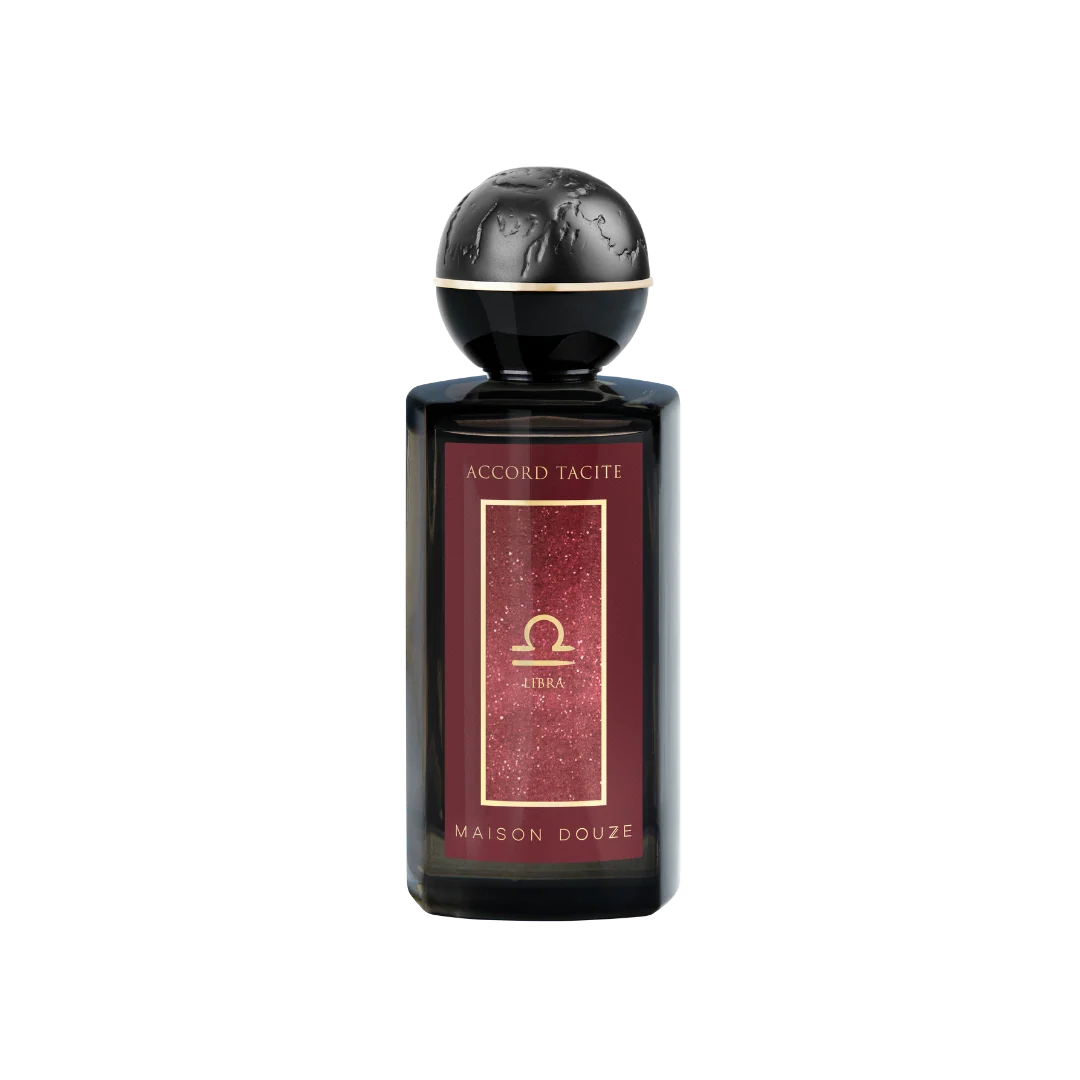
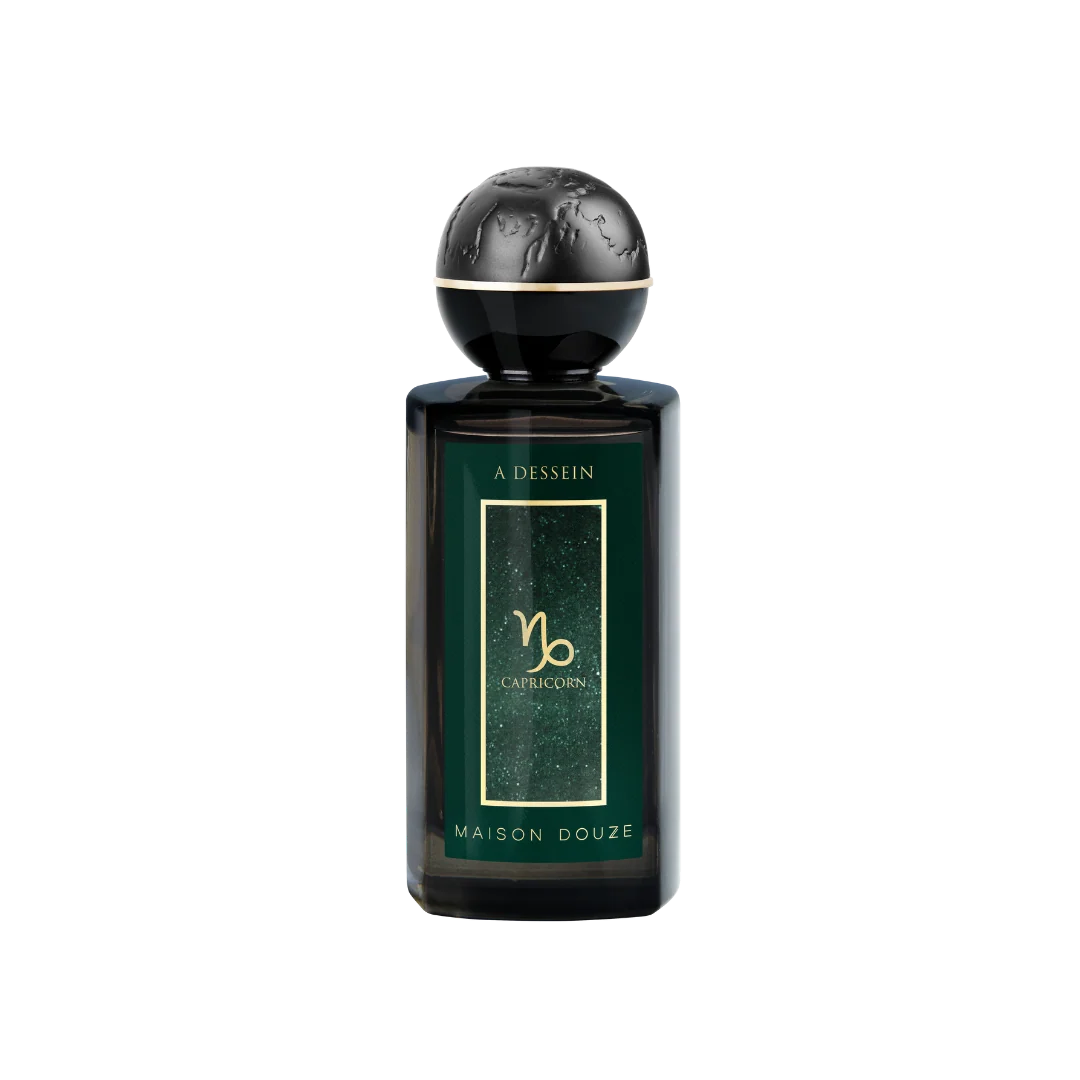
Across current official product imagery, the zodiac fragrances share a tall, dark rectangular bottle with softened shoulders and a large spherical upper element. The centre of the front face is occupied by a tall, narrow framed panel. Within that panel, colour, fragrance name and zodiac symbol provide the most obvious SKU-level changes.
Compare Accord Tacite with A Dessein. The former uses a burgundy-red presentation for Libra; the latter shifts to a deep green treatment for Capricorn. The bottle silhouette, upper geometry and basic label proportions remain closely aligned. Visually, this suppresses structural variation while letting graphic coding do more of the differentiation work.
From a manufacturing perspective, that visual effect should not be converted into an unsupported claim about how Maison Douze actually sources its bottles. The brand has not publicly confirmed whether its structure is stock-based or proprietary. The broader product-development principle is still relevant: when a brand keeps one bottle architecture across many SKUs, colour consistency, artwork control, print or label registration and secondary-packaging coordination become more important because small deviations are easier to notice across a repeated family.
For founders considering a comparable strategy, ready-design perfume bottles are one route for building multiple identities around an existing physical format through decoration, caps, labels and boxes. That is a general development comparison only; there is no evidence that Maison Douze uses HIVEDA or a ready-design sourcing model.
Accord Tacite Shows How the Zodiac Graphics Have Changed
Accord Tacite offers an unusually clear view of how Maison Douze’s packaging language has evolved because official imagery exists for the same Libra fragrance at different moments. In an April 2022 Maison Flamel astrology article, the bottle’s central panel carries a line-drawn constellation against a pink-red field. The current product image instead presents the Libra glyph much more directly inside a burgundy panel.
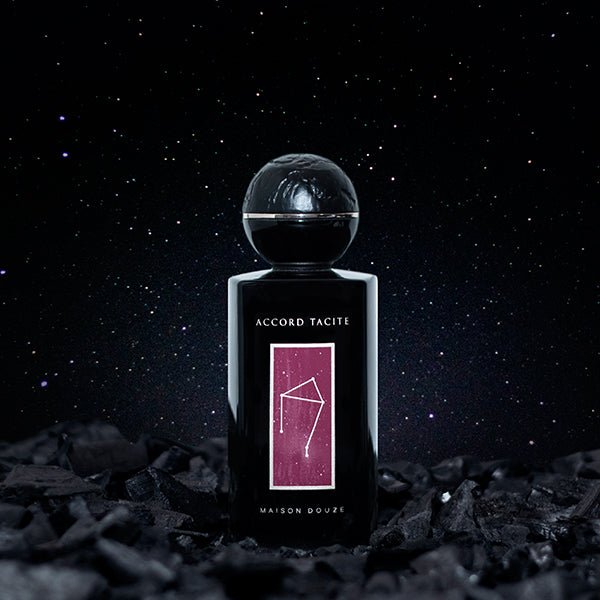
The reason for the change is not documented, so it would be risky to claim that the redesign was intended to simplify navigation or improve shelf recognition. What can be said is that its visible effect is different. The current glyph reduces the amount of interpretation needed to identify the astrological category, while the retained bottle shape and framed-panel format preserve continuity with the earlier version.
For a multi-SKU collection, that distinction matters. A packaging system can evolve without replacing its largest structural component. Graphic refreshes, symbol changes and revised colour treatments can alter the speed and clarity of recognition while leaving the main bottle architecture intact. Accord Tacite makes that mechanism visible within one Maison Douze product rather than requiring a comparison between unrelated fragrances.
The Discovery Set Turns a Large Concept Into a Trial Format
Twelve full-size fragrances create a strong conceptual statement, but they also create a discovery problem. A customer encountering Maison Douze for the first time has twelve archetypes, twelve names and twelve olfactory stories to understand. The house’s zodiac discovery set compresses that system into twelve 5 ml fragrances, giving every original sign equal representation in one 60 ml set.
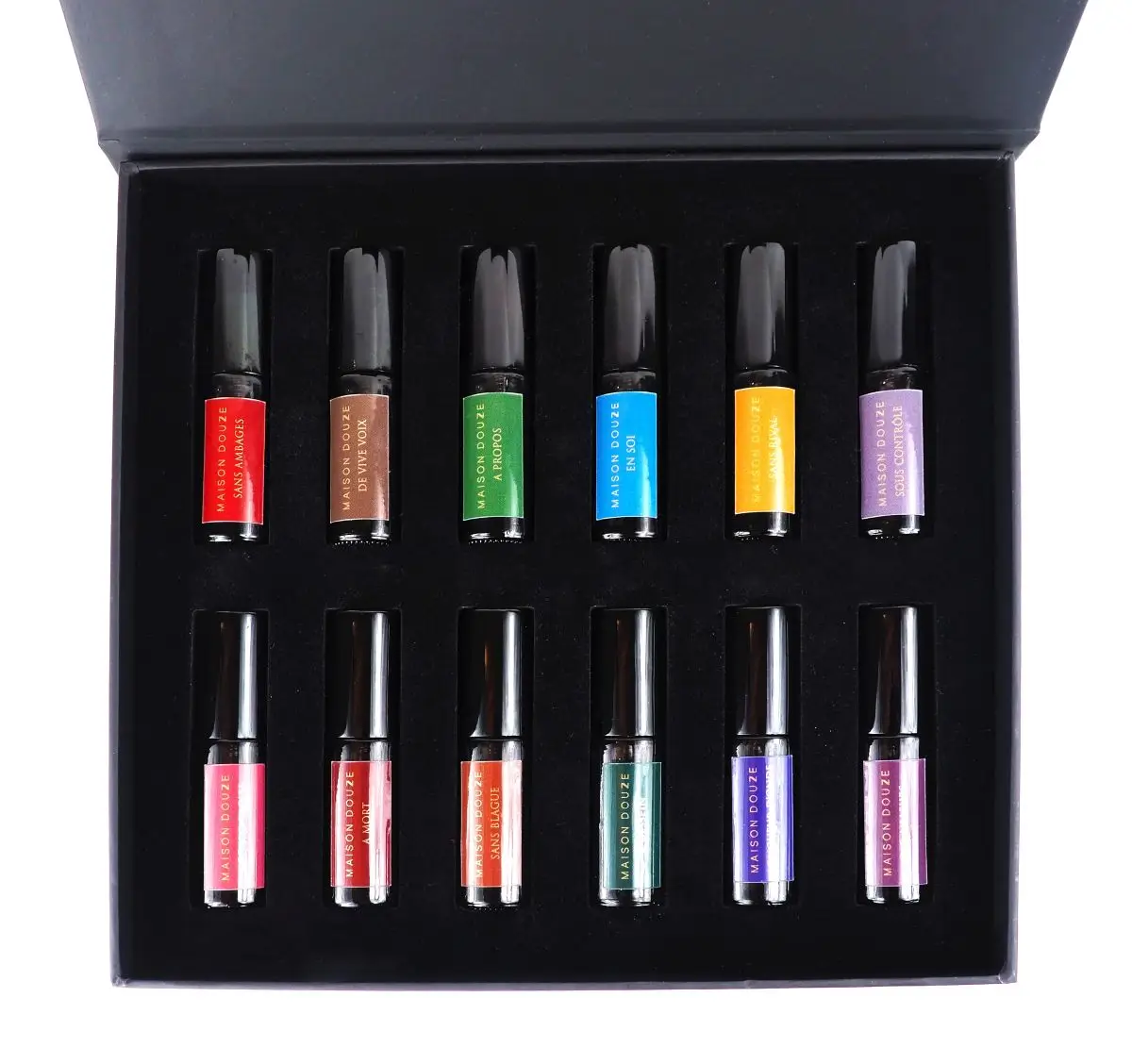
Sampling is particularly well matched to Maison Douze because the brand itself rejects the idea that a customer must wear their own sun sign. In Zakharia’s interview with Le Prescripteur, he describes guiding customers toward a fragrance according to the quality or energy they are seeking rather than merely matching a date of birth. The discovery format supports that behaviour: the consumer can compare identities instead of treating astrology as a one-answer sorting tool.
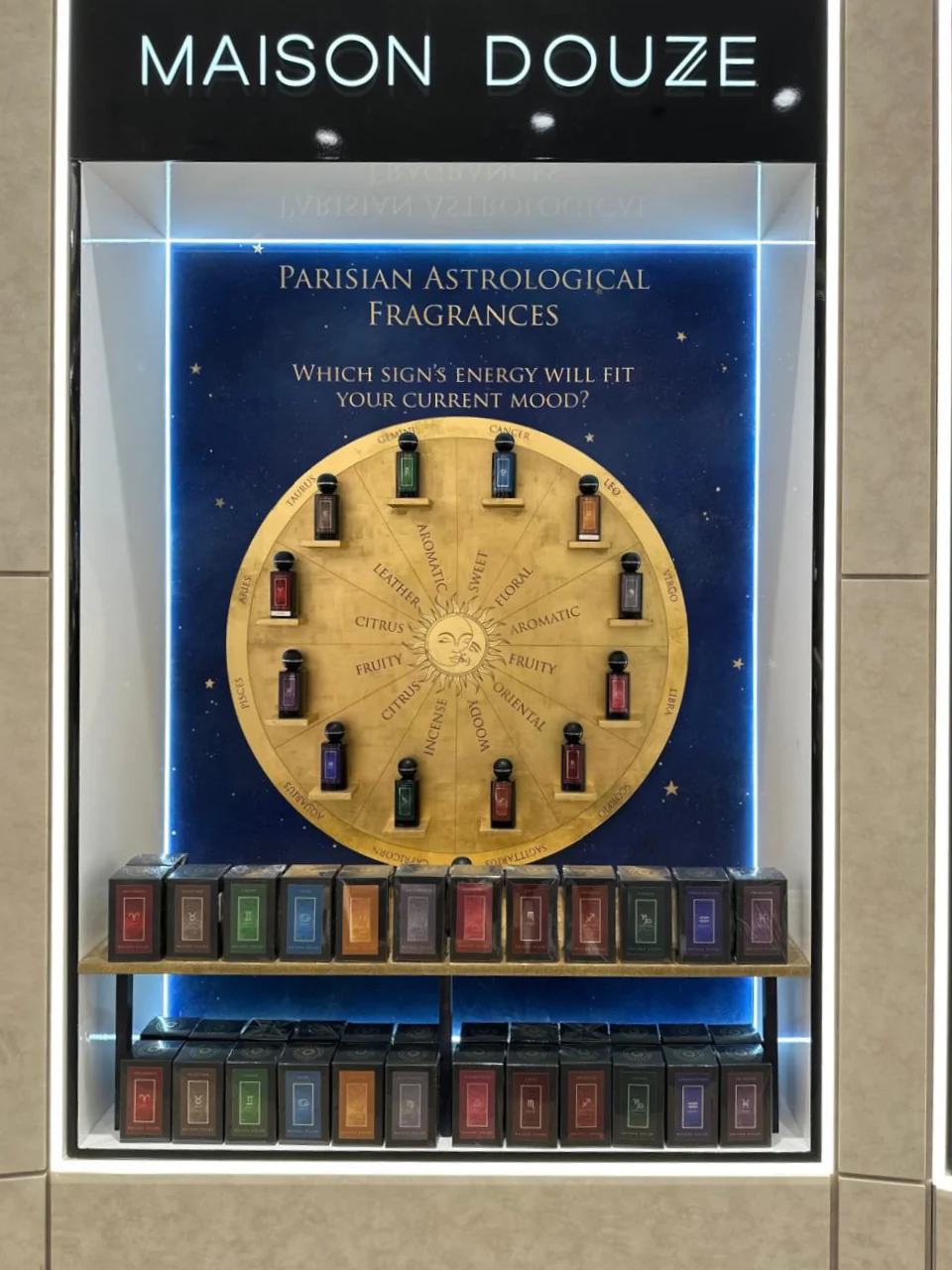
Retail presentation can make the same system more visible. An official Maison Flamel page for FACES shows Maison Douze bottles arranged around a large circular astrological display, with a prompt asking which sign’s energy fits the customer’s current mood. The display translates an abstract brand idea into a physical selection interface: repeated bottles become points on a visual map.
Four Elements and Solstice Gourmand Stretch the Original Zodiac Grid
A twelve-sign system is naturally complete. That completeness creates a challenge when a brand wants to grow: adding a thirteenth zodiac sign is impossible, so expansion has to happen through another classification layer. Maison Douze has done that by moving outward from the signs themselves.
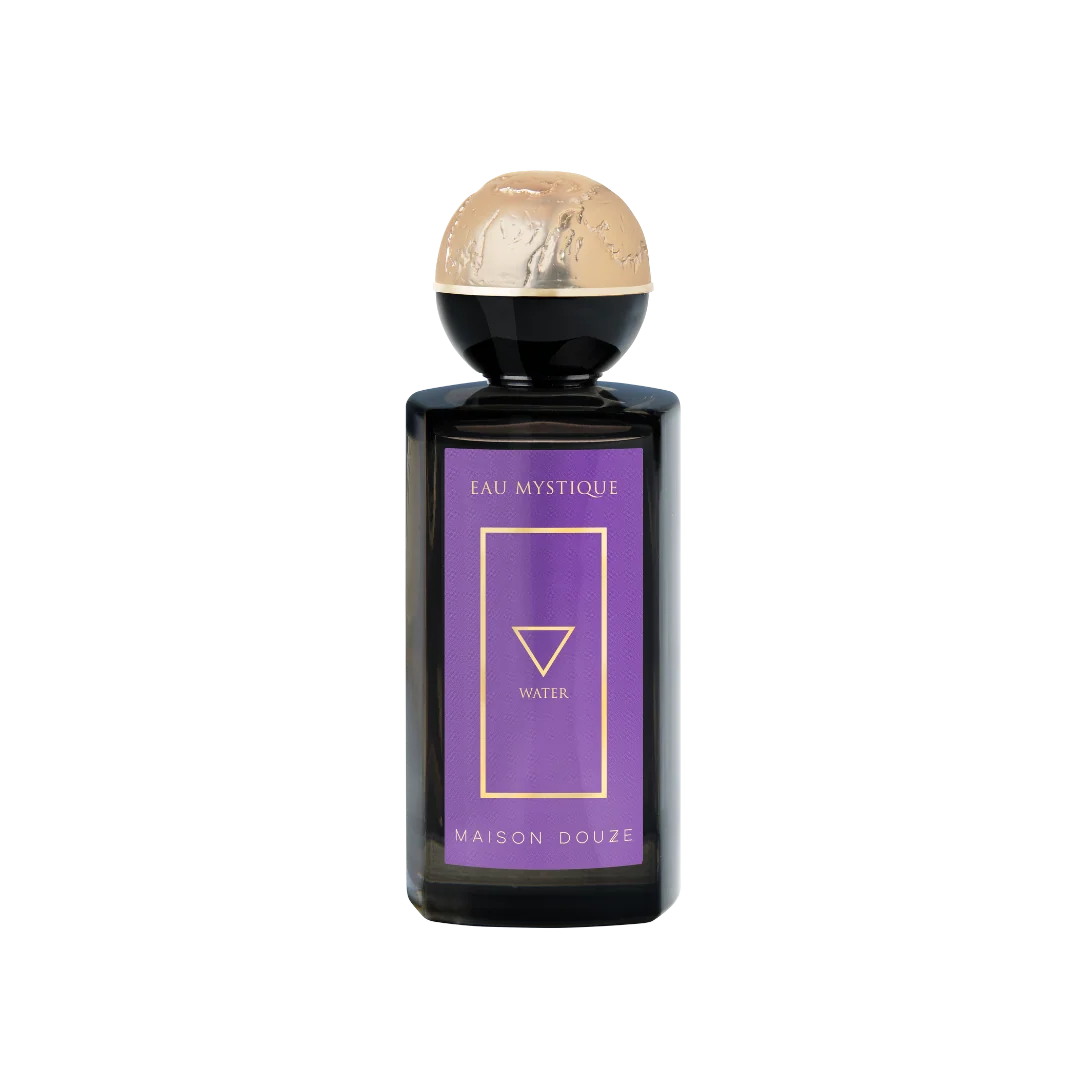
The four-element collection groups the astrological universe into Fire, Earth, Air and Water. Its discovery set contains Feu Magicien, Terre Authentique, Air Poésie and Eau Mystique, again at 5 ml each. Eau Mystique still uses the familiar dark upright bottle, but the central panel becomes purple and uses an elemental symbol rather than a zodiac glyph.
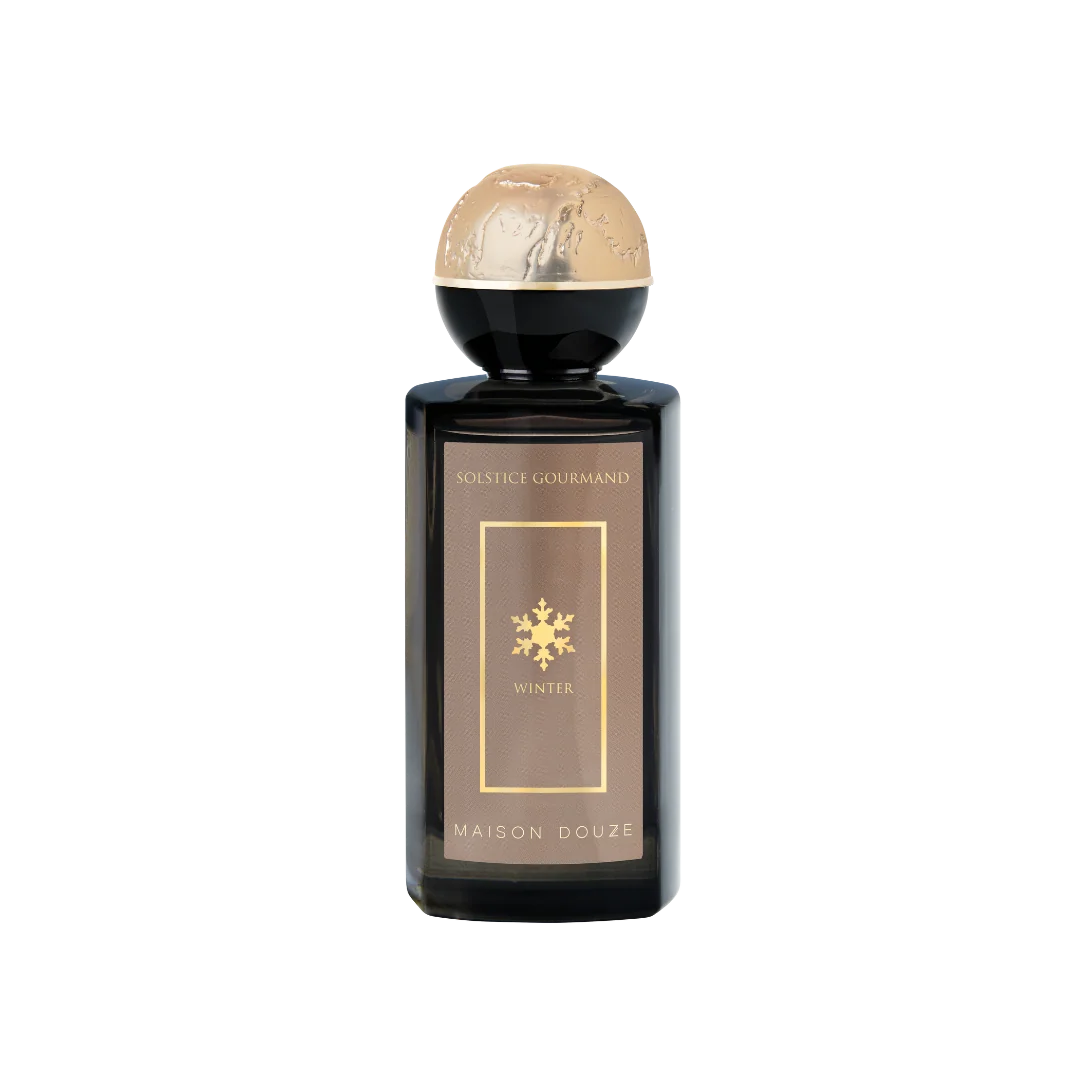
Solstice Gourmand moves even farther from the original twelve-sign taxonomy. The brand describes it as a tribute to the winter solstice, with cardamom, iris, tonka, salted caramel and vanilla. Its official still-life keeps the recognisable dark bottle at the centre but surrounds it with confectionery and ingredient references against a warm peach-toned environment.
The commercial implication is subtle but useful. The original zodiac system creates recognition through a finite set of twelve symbols. Once Maison Douze moves into elements and solstice narratives, the words and symbols on the panel have to carry different kinds of meaning. The repeated bottle therefore becomes increasingly valuable as a bridge between categories that are related conceptually but no longer belong to one simple twelve-part grid.
The Bottle Becomes the Fixed Point in Maison Douze’s Expanding Cosmos
Maison Douze’s packaging is most interesting when viewed as infrastructure rather than decoration. The original collection begins with an unusually rigid conceptual structure: twelve people, twelve zodiac archetypes and twelve fragrances. The bottle gives those personalities one recognisable body, while its narrow central panel creates a controlled area in which colour, name and symbol can change.
As the range expands, that division of labour becomes more important. A Capricorn fragrance, a Water-element fragrance and a winter-solstice gourmand do not communicate exactly the same classification, yet they can still read as members of one Maison Douze universe because the physical grammar remains familiar. The brand does not need every new story to reproduce the original zodiac logic literally.
For fragrance founders and packaging buyers, the useful point is not to copy Maison Douze’s astrology. It is to notice how a collection can separate what must stay fixed from what needs room to evolve. A stable silhouette can reduce visual fragmentation across a growing assortment, while a disciplined graphic zone gives the brand somewhere to introduce new categories. Maison Douze’s expanding cosmos works because the story keeps moving, but the object at its centre remains recognisable.